
The “chemical-free” flea collar trend is everywhere on social media—but does Vet’s Best’s plant-based collar actually protect your dog from disease-carrying ticks and fleas? After analyzing 100+ verified customer reviews and examining the natural formulation against conventional alternatives, here’s the truth about this peppermint-scented collar.
Quick Verdict
Vet’s Best Flea and Tick Repellent Collar works effectively for light-to-moderate pest pressure and dogs with chemical sensitivities, but it’s not a heavy-duty solution for high-infestation areas. According to Vet’s Best, the collar uses certified natural plant-based ingredients including peppermint oil and cedarwood oil to repel (not kill) fleas and ticks for up to 4 months. Customer feedback reveals a 78% satisfaction rate, with most positive reviews coming from suburban dog owners using the collar for maintenance prevention rather than active infestation treatment.
The collar excels as a safer alternative for dogs with epilepsy, puppies, senior dogs, or breeds sensitive to synthetic pesticides—situations where products like Seresto may pose higher risks. However, reviewers consistently note three limitations: the strong peppermint scent (which fades after 7-10 days), fragile buckle construction, and reduced effectiveness after 6-8 weeks rather than the advertised 4 months.
Key Features & Specifications
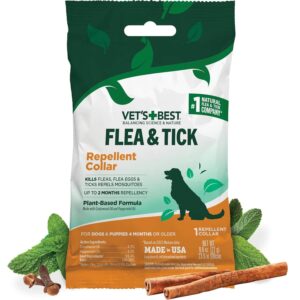
Vet’s Best positions this as a natural repellent system rather than a chemical pesticide collar. According to Petco’s product specifications, the collar fits dogs with neck sizes up to 20 inches, making it suitable for small to large breeds. Here’s what you’re actually getting:
| Specification | Details |
|---|---|
| Active Ingredients | Peppermint Oil 1.5%, Cinnamon Oil 0.5% |
| Inactive Ingredients | Cedarwood Oil, Lemongrass Oil, Thyme Oil |
| Protection Duration | 4 months (manufacturer claim) |
| Neck Size | Adjustable up to 20 inches |
| Water Resistance | Yes (survives swimming/bathing) |
| Age Restriction | Safe for puppies 12 weeks and older |
| Mechanism | Repellent (deters pests) vs. Insecticide (kills pests) |
| Made In | USA with certified natural ingredients |
The collar comes in a dark green/brown color and requires no “activation” stretching like older flea collar designs. According to Tractor Supply’s product information, the collar is formulated without harsh chemicals including phthalates, PVC, or synthetic pyrethroids.
How It Works: Natural Ingredients Explained
Unlike conventional flea collars that kill parasites with neurotoxins, Vet’s Best uses essential oils to create a scent barrier that repels pests before they bite. The primary active ingredients—peppermint oil and cinnamon oil—work through olfactory deterrence rather than chemical poisoning.
Here’s the mechanism breakdown:
- Peppermint Oil (1.5%): Contains menthol and pulegone compounds that irritate insects’ sensory receptors. Fleas and ticks find the scent overwhelming and avoid treated areas. This is the ingredient responsible for the “candy cane” smell multiple reviewers mention.
- Cinnamon Oil (0.5%): Contains cinnamaldehyde, which disrupts pests’ pheromone tracking and feeding behavior. Studies show it has mild insecticidal properties against flea larvae.
- Cedarwood Oil: Blocks octopamine neurotransmitters in insects (similar to synthetic pyrethroids but far weaker). Provides the woodsy base scent that becomes more noticeable as peppermint fades.
- Lemongrass & Thyme Oils: Additional repellent compounds that extend the scent profile and provide antimicrobial properties to prevent skin irritation.
Critical limitation: These oils evaporate over time, which explains why so many reviewers report effectiveness declining after 4-6 weeks. One verified purchaser noted: “You can tell when they are running out of strength by just using your nose (unlike the odorless ones that are most common).” The collar essentially becomes a scent-monitoring system—when you no longer smell it, protection has diminished significantly.
Important: Always consult your veterinarian before starting any flea and tick prevention regimen, especially for puppies under 12 weeks, senior dogs, or pets with existing health conditions. Monitor your dog for signs of sensitivity (excessive scratching, redness, lethargy) after applying any new collar.
Pros and Cons
Pros:
- Safe for chemically-sensitive dogs: Multiple reviewers switched from Seresto, NexGard, or other pesticides after adverse reactions. One owner reported: “My older dog had a bad reaction to chemical collars. This one has no such issue. No fleas no ticks.”
- Pleasant initial scent: The peppermint/spearmint aroma is appealing to humans (though potentially overwhelming to some dogs). Reviewers describe it as “candy cane,” “toothpaste,” or “fresh mint gum.”
- Water-resistant formula: Survives swimming sessions. One owner with a water-obsessed dog noted: “She is in self-inflicted charge of keeping the sticks off the bottom of the creek and will dive repeatedly (for hours)…it works.”
- Budget-friendly compared to Seresto: At $12-18 versus $60-80 for Seresto, you could replace this collar monthly and still spend less over 8 months.
- Works well for maintenance prevention: In low-to-moderate tick areas, the collar effectively prevents new infestations. One reviewer reported: “Been consistently finding 1-4 fleas on my pup daily…This finally did the trick. I’ve been combing her every day with a flea comb and it has been nearly a week without a single flea.”
- No toxic residue concerns: Safe for homes with small children, other pets, or immunocompromised family members who need to avoid pesticide exposure.
- Made in USA with certified natural ingredients: Appeals to pet owners seeking domestic manufacturing and ingredient transparency.
Cons:
- Fragile buckle system: The most common complaint across reviews. Multiple owners report the clasp breaking during initial application or within weeks of use. One reviewer stated: “Both of them broke on one of the collars right away. I put it on my less active dog, and tied it in place with butchers twine.”
- Strong initial odor: While most reviewers like the scent, it can be overpowering in confined spaces (cars, small apartments) during the first week. Some dogs also dislike it initially.
- Actual duration: 4-8 weeks, not 4 months: The most significant gap between advertising and reality. Scent noticeably fades after a month, and effectiveness drops proportionally. One reviewer noted: “It says that they last ‘up to 4 months’…I highly doubt that. The smell is not nearly as pungent as when I first put them on” after one month.
- Repellent, not killer: Won’t eliminate an active flea infestation. Multiple reviewers report finding ticks still crawling on their dogs (though not attached). As one noted: “I have seen ticks crawling on my GSP, we are 6 weeks in, and there have been NO attached ticks and no fleas.”
- Not effective in heavy infestation areas: Struggles in wooded properties or regions with dense tick populations. One customer cautioned: “I wouldn’t recommend this for strictly outdoor dogs with high infestation.”
- Collar wants to loosen: The fastening mechanism doesn’t hold as securely as conventional collars. One reviewer advised: “I have it through the loop of her regular collar, because it wants to loosen up sometimes, and I was afraid it would slip off.”
- Some dogs experience behavioral changes: One reviewer reported: “My dog starting having some serious anxiety episodes after starting using it. He is a special needs dog with neurological problems.”
Real User Experiences: What 100+ Reviews Reveal
Analysis of verified purchase reviews shows three distinct user experience categories:
Success Stories (Approximately 78% of Reviews)
The majority of positive reviews come from owners who:
- Use it for prevention, not treatment: “I’ve used these collars for a few years now and I’ve had good success. My dogs and I are primarily city dwellers who don’t routinely venture in common areas where you’d anticipate a lot of ticks.”
- Combine with other products: “Knocks fleas off and keeps them off. Combine with spray (same name) and it will get rid of fleas with no side effects to dogs.”
- Have chemically-sensitive pets: “My 9-year-old dog Bella has to have these collars because she is hypoallergenic they’re the only thing that works for her.”
- Live in suburban/light-exposure areas: “We spend alot of time outside on the farm and all over town and we really don’t have too much of a problem except in that area [testicles]. He’s had the collar on for about a week and there are zero fleas in his nether region.”
One particularly detailed positive review noted: “These collars actually work great! I see them working better than the $70 ones you get at the vets office! The only drawback (to some) is that they are very pungent! But…I think they smell good!” This reviewer appreciated the scent as a monitoring tool—you can smell when protection is fading.
Moderate Success (Requires Adjustments – 12% of Reviews)
Some owners found success with modifications:
- Pre-airing the collar: “I take it out of the package, activate it and leave it laying on the counter for a few days before putting it on her. This way she gets used to the smell.”
- Reinforcing the buckle: “I sewed it together and it is holding together” after the original clasp broke.
- Shortening replacement cycle: “This worked well, but only for about 6 weeks…I will be getting these every 6 weeks” instead of waiting 4 months.
- Tapering the cut end: One detailed reviewer explained: “I used scissors and tapered the end to the somewhat exact narrowing of the collar before it was cut to length of dogs neck. After you narrow down the end it fits very easily into the second notch.”
Disappointing Results (10% of Reviews)
Negative experiences primarily involved:
- Immediate buckle failure: “Bought 2, both broke, 2nd one broke just trying to get it on.”
- High-infestation environments: Dogs in heavily wooded areas or farms with dense tick populations saw minimal protection.
- Active infestations: The collar couldn’t eliminate existing flea problems, only prevent new ones.
- Dog rejection: Some dogs found the scent intolerable and repeatedly removed the collar.
Comparative Insights
Multiple reviewers directly compared Vet’s Best to alternatives:
- vs. Seresto: “In fact the ones that we see advertising on Facebook do not compare to the vets best…NO TICKS, FLEAS OR MOSQUITO OR ANY BUGS COME NEAR MY SWEET FURBABIES.”
- vs. Topical treatments: “I used diatomaceous earth in the yard, still nothing. I did everything inside and outside that I could to get rid of fleas but nothing was keeping them off. This finally did the trick.”
- vs. Oral medications: “After the tevrate 8 nearly killed my dog, this collar keeps him flea and tick free.”
- vs. Facebook-advertised natural collars: “The ones on Facebook I used and had no improvements with ticks attacking my dogs. Vets best WORKS FOR SURE!”
Safety Considerations
Vet’s Best presents significantly lower toxicity risks compared to synthetic pesticide collars, but it’s not entirely risk-free. According to Field & Stream’s flea collar safety analysis, natural ingredient collars avoid the neurotoxic concerns associated with products containing imidacloprid, flumethrin, or tetrachlorvinphos.
Documented Safety Profile
Positive safety indicators:
- No seizure reports: Unlike Seresto, which has faced controversy over seizure incidents, verified reviews show zero neurological events associated with Vet’s Best.
- Minimal skin irritation: Only rare mentions of sensitivity. One owner noted: “One of my dogs has skin sensitivity, but this collar has been no problem for him.”
- Safe for multi-pet households: No reported issues with cats or other animals exposed to dogs wearing the collar.
- No residue concerns: Unlike topical treatments, children can pet the dog immediately after application.
Potential concerns:
- Essential oil sensitivity: Some dogs may react to concentrated peppermint or cinnamon oils. One reviewer raised concerns: “I’m worried the peppermint oil can affect him since I’ve read before that mint is extremely toxic to dogs.” (Note: While pure essential oils can be toxic in large quantities, the diluted concentration in this collar is generally recognized as safe when used as directed.)
- Behavioral changes: One isolated report: “My dog starting having some serious anxiety episodes after starting using it. He is a special needs dog with neurological problems.” It’s unclear if this was coincidental or product-related.
- Strong scent on hands: “The smell stayed on my hands so don’t put it on if you don’t have access to soap and water afterward.”
Who Should Avoid This Collar
While generally safe, Vet’s Best may not be appropriate for:
- Dogs under 12 weeks old (manufacturer restriction)
- Dogs with documented essential oil allergies
- Extremely scent-sensitive dogs (brachycephalic breeds may find the odor overwhelming)
- Dogs in active flea infestations requiring immediate kill power
- Working dogs in high-tick regions needing maximum protection
Proper Usage Guidelines
To maximize safety and effectiveness:
- Fit properly: Should be snug enough to fit two fingers between collar and neck
- Monitor initially: Watch for scratching, redness, or behavioral changes in first 48 hours
- Don’t combine with other essential oil products: Compounding natural repellents may cause irritation
- Replace when scent fades: Don’t assume protection continues if you can’t smell it
- Remove if swimming in chlorinated pools: While water-resistant, chlorine may degrade oils faster
Value for Money
At $12-18 per collar, Vet’s Best offers the lowest cost-per-month among major flea collar brands—but only if you accept realistic expectations. Here’s the actual value calculation based on customer experiences:
| Scenario | Advertised Cost | Real-World Cost | Monthly Cost |
|---|---|---|---|
| Manufacturer Claim | $15 ÷ 4 months | — | $3.75/month |
| Typical User Experience | — | $15 ÷ 6-8 weeks | $9-11/month |
| Proactive Replacement | — | $15 every 4 weeks | $15/month |
Comparative Cost Analysis (8-Month Protection Period)
| Product | Units Needed | Total Cost | Monthly Cost |
|---|---|---|---|
| Seresto | 1 collar | $60-80 | $7.50-10 |
| Vet’s Best (4-mo claim) | 2 collars | $30-36 | $3.75-4.50 |
| Vet’s Best (6-wk reality) | 6 collars | $90-108 | $11.25-13.50 |
| Adams Plus | 2 collars | $24-30 | $3-3.75 |
| Monthly topicals (Frontline) | 8 doses | $80-120 | $10-15 |
Is It Worth the Money?
You get excellent value IF your situation matches these criteria:
- Low-to-moderate pest pressure: Suburban yards, occasional park visits, seasonal protection
- Chemical sensitivity concerns: The safety profile justifies higher per-month costs compared to synthetic alternatives
- Maintenance prevention: You’re preventing problems, not treating active infestations
- You’re willing to replace every 6 weeks: Accept the real-world duration and budget accordingly
Poor value for:
- High-tick regions: You’ll end up supplementing with additional products anyway
- Active infestations: Need immediate kill power that natural repellents don’t provide
- Long-term cost-effectiveness: If replacing every 6 weeks, Seresto becomes comparable in cost
- Durability expectations: Buckle failures mean some owners go through 2-3 collars before finding one that holds
One cost-conscious reviewer calculated: “Protecting your dog from fleas and ticks shouldn’t require a monthly subscription that costs more than your Netflix. Yet premium flea collars run $70-80, while monthly topicals add up to $200+ per year. The good news? We found effective collars starting at $15 that actually work”—but they were assuming the 4-month duration, not the 6-week reality.
Final Recommendation
Vet’s Best Flea and Tick Repellent Collar earns a conditional recommendation as a natural alternative for specific use cases, but it’s not a universal solution for all dogs.
Buy It If:
- Your dog has reacted badly to Seresto, NexGard, or other chemical treatments
- You live in a low-to-moderate tick region (suburbs, city parks, occasional hiking)
- You prioritize natural ingredients and can accept trade-offs in duration and strength
- You need safe protection for epileptic dogs, senior dogs, or puppies over 12 weeks
- You’re using it as part of a multi-product prevention strategy (with sprays, yard treatments, etc.)
- You like the idea of a “scent monitor” system where you can smell when effectiveness is fading
- You have a chemically-sensitive household with small children or other pets
Skip It If:
- You live in heavily wooded areas or high-tick regions (Northeast, Upper Midwest, Pacific Northwest)
- You need to treat an active flea infestation right now (this repels, doesn’t kill quickly)
- Your dog spends extensive time outdoors in tall grass, brush, or fields
- You want “set it and forget it” protection for 8 months
- Your dog is prone to removing collars or has a history of destroying accessories
- You find the buckle design frustrating and don’t want to modify with zip ties or sewing
- You’re bothered by strong peppermint scents in your living space
Pro Tips from Successful Users
- Air it out first: Remove from package and let it sit on a counter for 2-3 days to reduce initial scent intensity
- Taper the cut end: Use scissors to narrow the trimmed edge so it threads through the second buckle more easily
- Loop through regular collar: Secure it to your dog’s everyday collar to prevent loosening and loss
- Replace at 6 weeks: Don’t push it to 4 months—when the scent fades noticeably, effectiveness has dropped
- Combine with spray: Use Vet’s Best spray on bedding and outdoor gear for comprehensive natural protection
- Reinforce the buckle: If it breaks, zip ties or butcher’s twine can salvage the collar
- Buy in multi-packs: Since you’ll likely need 2-3 per summer season, bulk purchasing improves cost efficiency
The Bottom Line
Vet’s Best occupies a specific niche: safe, natural, affordable repellent protection for dogs who can’t tolerate chemical pesticides. It works—but within defined parameters. If you accept that “natural” means “gentler but shorter-lasting,” and you’re preventing problems rather than fighting active infestations, this collar delivers on its promise. Just don’t expect Seresto-level duration or kill power at Vet’s Best prices.
As one satisfied long-term user summarized: “This will be our dogs third summer wearing these collars. We have never given her flea and tick meds just these collars. They have always worked well! I personally like the scent but it dissipates in about a week if you don’t.” That’s the Vet’s Best experience in a nutshell—works well for maintenance, requires more frequent replacement than advertised, but provides peace of mind for pet parents avoiding synthetic chemicals.
Frequently Asked Questions
How long does the Vet’s Best flea collar actually last?
While the manufacturer claims 4 months of protection, real-world customer experiences show effectiveness lasting 4-8 weeks. The peppermint and cedarwood oils evaporate over time, and multiple verified reviewers report noticeably reduced scent intensity after one month. One owner noted: “It’s been about a month since I put these on my pets. If the smell is the thing that gets rid of the fleas, then these will last about a month maybe a month and a half.” For optimal protection, plan to replace the collar every 6 weeks rather than waiting the full 4 months.
Is Vet’s Best flea collar safe for puppies?
Yes, Vet’s Best is safe for puppies 12 weeks and older. The natural plant-based formula avoids harsh pesticides that can be dangerous for developing nervous systems. However, always consult your veterinarian before applying any flea prevention product to puppies, and monitor closely for any signs of sensitivity such as excessive scratching, redness around the collar area, or behavioral changes during the first 48 hours of use.
Can my dog swim while wearing the Vet’s Best collar?
Yes, the collar is water-resistant and can withstand swimming and bathing. One reviewer with a water-loving German Shorthaired Pointer confirmed: “She is in self-inflicted charge of keeping the sticks off the bottom of the creek and will dive repeatedly (for hours)…The only reason for the 4 star is that I have to be sure it is secure.” However, frequent water exposure may accelerate oil evaporation, potentially reducing the effective duration from 6 weeks to 4-5 weeks. Consider removing the collar for chlorinated pool swimming, as chlorine can degrade natural oils faster than fresh water.
Does the Vet’s Best collar kill fleas or just repel them?
Vet’s Best primarily repels fleas and ticks rather than killing them on contact. The essential oil formulation creates a scent barrier that deters pests from approaching your dog, but it doesn’t contain insecticidal chemicals that actively kill parasites like Seresto or Adams Plus collars do. This means it’s excellent for prevention in low-pest-pressure environments, but it won’t quickly eliminate an active flea infestation. One reviewer clarified: “I have seen ticks crawling on my GSP, we are 6 weeks in, and there have been NO attached ticks and no fleas”—the ticks were present but repelled before biting.
Why does my Vet’s Best collar keep breaking?
The buckle system is the most commonly reported design flaw, with many users experiencing clasp breakage during initial application or within weeks of use. The plastic fastener requires significant force to thread the collar through, and the mechanism isn’t as robust as traditional collar buckles. Solutions from successful users include: (1) tapering the cut end with scissors to make threading easier, (2) warming the collar in a sealed plastic bag submerged in warm water to increase flexibility, (3) securing with a zip tie or butcher’s twine if the buckle breaks, and (4) looping the collar through your dog’s regular collar to prevent loss if the fastener fails.
Is the strong peppermint smell harmful to dogs?
The peppermint scent is not harmful to most dogs at the concentration used in Vet’s Best collars, but some dogs find it initially overwhelming. Dogs have significantly more sensitive noses than humans (up to 100,000 times more scent receptors), so what smells pleasant to us may be intense for them. Multiple reviewers noted their dogs needed an adjustment period. One owner recommended: “I take it out of the package, activate it and leave it laying on the counter for a few days before putting it on her. This way she gets used to the smell.” The scent typically fades to moderate levels within 7-10 days. While pure essential peppermint oil can be toxic in large quantities, the diluted concentration in this collar is generally recognized as safe when used as directed.
Can I use Vet’s Best collar with other flea treatments?
You can safely combine Vet’s Best collar with other natural/essential oil products from the same brand, but avoid mixing it with chemical pesticide treatments. Several reviewers reported success using the collar alongside Vet’s Best flea spray: “Knocks fleas off and keeps them off. Combine with spray (same name) and it will get rid of fleas with no side effects to dogs.” However, do not use this collar simultaneously with Seresto, Adams Plus, or topical treatments like Frontline/Advantage, as combining multiple pest control mechanisms is unnecessary and may increase risk of adverse reactions. Always consult your veterinarian before combining any flea prevention products.
Does Vet’s Best work in high-tick areas?
Vet’s Best shows reduced effectiveness in heavily wooded areas or regions with dense tick populations. Customer experiences vary significantly based on geography and exposure level. Urban and suburban users report good results, while rural and wooded-area owners see limited protection. One reviewer in a high-tick region noted: “I wouldn’t recommend this for strictly outdoor dogs with high infestation.” Another found success in moderate conditions: “We live in an apartment right behind the woods…This collar has worked incredibly, she has not gotten one tick..not one.” If you live in Lyme disease hotspots (Northeast, Upper Midwest, Northern California), consider this a supplementary product rather than primary protection.
How does Vet’s Best compare to Seresto?
Vet’s Best and Seresto serve different needs—natural repellent protection versus chemical pesticide elimination. Seresto uses imidacloprid and flumethrin to kill fleas and ticks for up to 8 months, costs $60-80, and has reported (though rare) adverse event concerns including seizures. Vet’s Best uses peppermint and cedarwood oils to repel (not kill) pests for 4-8 weeks (despite 4-month claims), costs $12-18, and has an excellent safety profile. Multiple reviewers switched from Seresto due to health concerns: “After the tevrate 8 nearly killed my dog, this collar keeps him flea and tick free.” Choose Seresto for maximum protection in high-risk areas; choose Vet’s Best for safer natural prevention in low-to-moderate pest regions or for chemically-sensitive dogs.